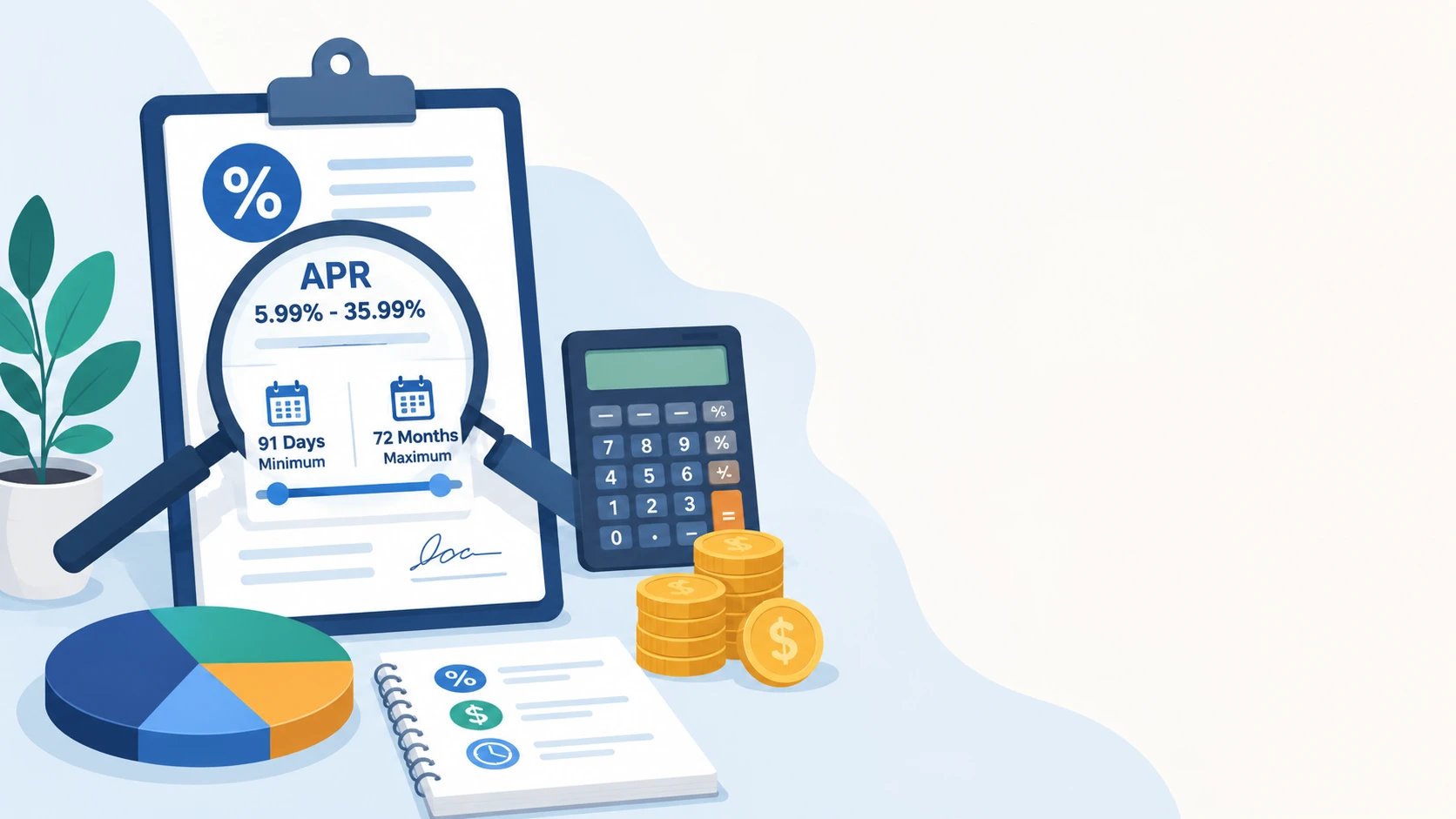
When you apply for any loan — including a Crane Finance installment loan — one number matters more than almost any other: the Annual Percentage Rate (APR). Yet APR is also one of the most misunderstood figures in consumer finance. Many borrowers focus on the monthly payment without fully calculating what they will pay in total over the life of the loan.
This guide explains what APR actually means, how finance charges are calculated, and how to use that information to compare loan options and make a responsible borrowing decision.
Key takeaway: APR represents the annual cost of borrowing expressed as a percentage. For short-term installment loans, the APR is typically high — which means understanding the total finance charge (not just the payment amount) is essential before you sign any loan agreement.
What Is APR?
APR stands for Annual Percentage Rate. It is a standardized measure of borrowing cost that expresses, as a yearly percentage, the total cost of credit — including interest and any required fees — relative to the loan amount. The federal Truth in Lending Act (TILA) requires all lenders, including Crane Finance, to disclose the APR clearly in your loan agreement before you sign.
APR is designed to give borrowers a consistent way to compare loans from different lenders. Because it is annualized, it allows you to compare a 6-month loan with a 24-month loan on a like-for-like basis — even though the actual dollar costs are very different.
APR vs. Interest Rate
These two terms are often confused but are not the same:
- Interest rate is the base cost of borrowing the principal, expressed as a percentage of the loan amount
- APR includes the interest rate plus any additional required costs (such as origination fees), expressed on an annualized basis
For installment loans with no origination fee — like those offered by Crane Finance — the APR and the stated interest rate may be equivalent or very close. Your loan agreement will disclose both figures explicitly.
What Is a Finance Charge?
The finance charge is the total dollar amount you will pay to borrow the money — the cost of the loan expressed in dollars rather than as a percentage. It includes interest and any required fees. This is arguably the most important number to review before signing a loan agreement, because it tells you directly how much the loan will cost you beyond what you borrowed.
For example: if you borrow $800 and your finance charge is $700, you will repay a total of $1,500. The finance charge of $700 represents the actual dollar cost of borrowing that $800.
TILA requires Crane Finance to disclose the finance charge in your loan agreement before you accept the offer. Never sign a loan agreement without reviewing this figure.
Why Is the APR on Short-Term Loans So High?
This is one of the most common questions borrowers have about installment loans from tribal and alternative lenders. The short answer is that APR is an annualized figure — and short-term loans have a compressing effect on that number.
Consider this: if you borrow $500 for 6 months and pay $400 in finance charges, you have paid 80% of the principal in fees over half a year. Annualized, that works out to a very high APR — even though $400 in actual charges on a $500 loan might seem manageable in absolute terms.
This does not mean the loan is inherently unfair, but it does mean:
- Short-term installment loans are significantly more expensive than traditional personal loans or credit cards
- You should compare the total dollar cost (finance charge) — not just the APR — when evaluating whether a loan fits your budget
- Borrowing only what you need and repaying as quickly as possible reduces your total cost
How to Calculate Your Total Repayment Cost
Before accepting any loan offer, use this simple formula:
Total repayment = Loan amount + Finance charge
Or equivalently: Total repayment = Number of payments × Payment amount
Crane Finance is required by TILA to disclose all of the following in your loan agreement before you sign:
- The loan amount (principal)
- The APR
- The finance charge (total dollar cost of borrowing)
- The total of payments (what you will have paid when the loan is fully repaid)
- The payment schedule (number of payments and due dates)
Read each of these figures carefully. Do not rely on the monthly payment amount alone to evaluate affordability — a low payment spread over many periods can produce a very high total cost.
Comparing Loan Types by True Cost
To put APR in context, here is a general comparison of how installment loans compare to other common credit products. Note that actual rates vary by lender, creditworthiness, and loan terms.
- Bank personal loans: Typically APRs of 6%–36%. Lower cost, but usually require good credit and take longer to fund
- Credit union personal loans: Often 8%–18%. Competitive rates, but membership required and processing may be slower
- Credit cards: Average APR around 20%–30% for new accounts. Revolving credit with minimum payment traps
- Tribal installment loans (e.g. Crane Finance): Higher APR. Higher cost of credit, but accessible to borrowers with limited credit history and can fund the same or next business day
- Payday loans: Extremely high effective APR. Full repayment in a single lump sum, often within two weeks
If a lower-cost option is available to you — a credit union loan, a bank personal loan, a community development financial institution (CDFI), or an employer advance — explore it first. An installment loan from Crane Finance is designed for situations where those options are not accessible or cannot address the need in time.
How Early Payoff Affects Your Total Cost
One meaningful advantage of a Crane Finance installment loan is that there is no prepayment penalty. This means you can pay off your loan before the final scheduled payment date without incurring any additional charges — and doing so will reduce the total finance charge you pay.
The interest on an installment loan accrues over time. The sooner you pay off the remaining balance, the less interest accumulates. If you come into additional funds — a tax refund, an unexpected bonus, or savings from reduced expenses — applying them toward your loan balance can meaningfully reduce your total cost.
If you plan to pay off your loan early, contact Crane Finance at 855-321-7654 or [email protected] to confirm the exact payoff amount, as accrued interest up to the payoff date will factor into the calculation.
Reading Your Loan Agreement
Before you e-sign, take time to locate and understand the following in your loan agreement:
- APR: The annualized cost of borrowing — useful for comparison
- Finance charge: The total dollar cost of the loan — the most important number for budgeting
- Amount financed: The net amount you actually receive (the principal)
- Total of payments: The sum you will have paid by the end of the repayment schedule
- Payment schedule: The date, amount, and number of each installment
- Late payment terms: What fees or consequences apply if a payment is missed
You are not required to accept a loan offer after reviewing these terms. If the total cost does not fit your budget, do not sign. Crane Finance will not pressure you to accept — and walking away from a loan that does not make financial sense for you is always the right decision.
If you want to understand how repayment strategies can help you manage a loan more effectively once you have accepted one, see our guide on smart strategies to manage and pay off your Crane Finance loan.
Final Thoughts
APR is a tool for comparison, but the finance charge — the actual dollar amount you will pay to borrow — is the number that matters most for your budget. Before accepting any loan offer from Crane Finance or any other lender, calculate your total repayment cost, confirm the payment schedule fits your income, and explore whether a lower-cost alternative is available to you.
Crane Finance is committed to transparent lending. All costs are disclosed in full before you sign. If you have questions about the terms of an offer, contact our customer service team before accepting. Ready to see your options without impacting your credit score? Visit the Crane Finance homepage to start a no-commitment rate check.
And if you are still evaluating whether debt consolidation might be a better fit for your financial situation, our article on debt consolidation covers the key considerations in detail.
Check your rate in minutes — no impact to your credit score.
Check My Rate — No Commitment →