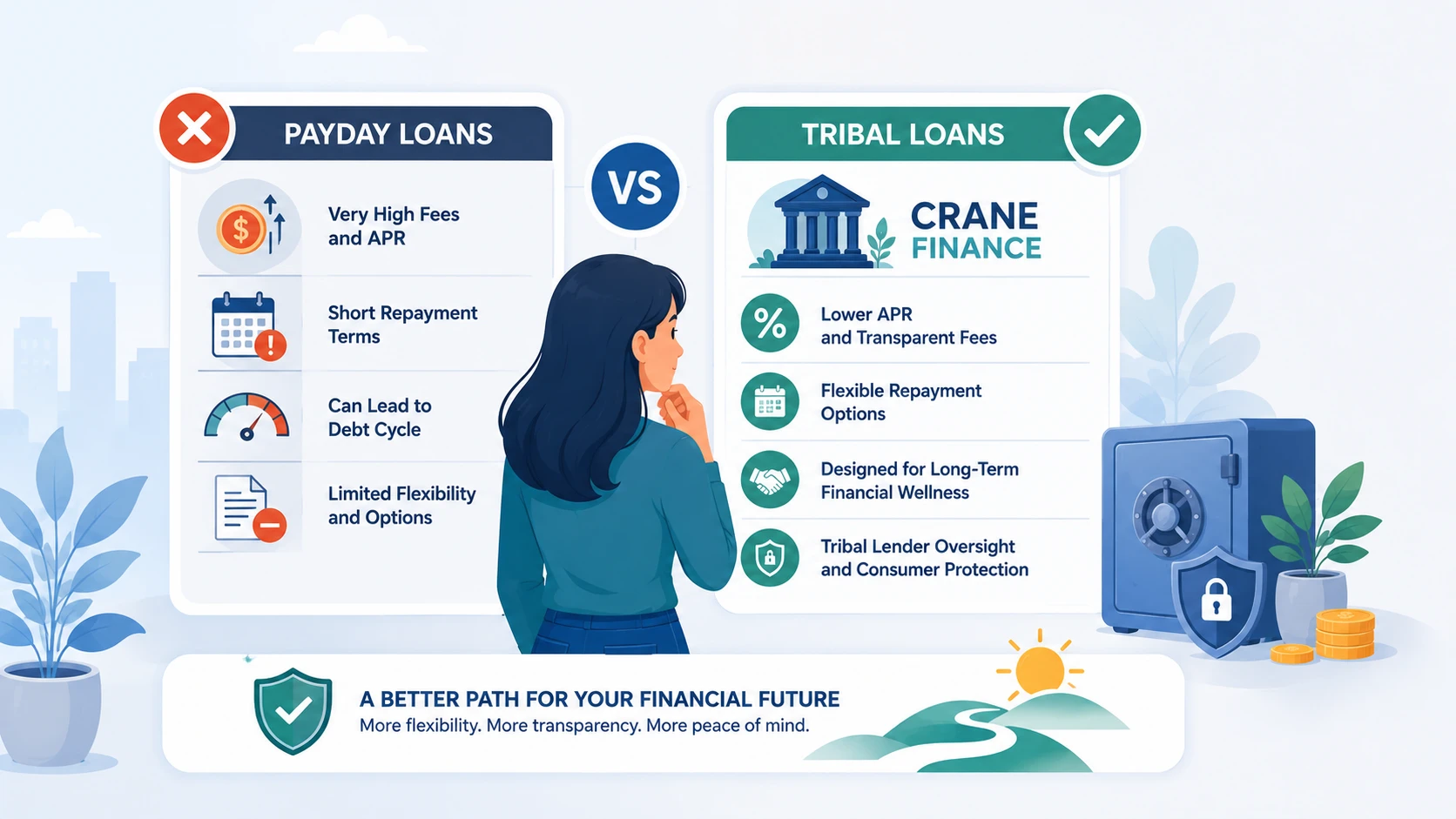
When you need cash quickly and traditional banks are not an option, two products frequently come up in a search: payday loans and tribal installment loans. Both serve borrowers who need short-term funds, and both are high-cost forms of credit. But they are structurally very different — and those differences have real consequences for your financial health.
This guide breaks down how payday loans and tribal installment loans compare across the dimensions that matter most: repayment structure, total cost, regulatory framework, and the risk of getting trapped in a cycle of debt.
Important note: Both payday loans and tribal installment loans are expensive forms of borrowing. This comparison is not an endorsement of either product. Always explore lower-cost alternatives — including credit unions, CDFIs, and nonprofit assistance programs — before applying for either type of loan.
What Is a Payday Loan?
A payday loan is a short-term, high-cost loan — typically $100 to $500 — that is designed to be repaid in full on your next payday, usually within two to four weeks. The lender gives you cash upfront and collects the full loan amount plus a flat fee when your next paycheck arrives.
Key characteristics of payday loans:
- Single lump-sum repayment: The entire principal plus fees is due at once, typically within 14 days
- Flat fee structure: Typically charged as a fee per $100 borrowed (e.g. $15 per $100), which translates to a very high effective APR
- State-regulated: Subject to state lending laws, which vary dramatically — some states cap fees, others ban payday loans outright, and some impose minimal restrictions
- Rollover risk: If you cannot repay the full amount on your next payday, many lenders allow you to "roll over" the loan — paying only the fee and extending the loan — which compounds fees rapidly
What Is a Tribal Installment Loan?
A tribal installment loan — like those offered by Crane Finance — is a loan offered by a lending company that operates as an economic arm of a federally recognized Native American tribe. Unlike a payday loan, it is repaid in multiple scheduled installments over a defined period, rather than in a single lump sum.
For a full explanation of how tribal lending works and the legal framework behind it, see our guide on what a tribal loan is.
Key characteristics of Crane Finance tribal installment loans:
- Installment repayment: Repaid through multiple scheduled payments aligned with your pay schedule — not a single lump sum
- Loan amounts: $100 to $1,500
- Tribal and federal law: Governed by the Menominee Indian Tribe of Wisconsin and applicable federal consumer finance law, not state lending statutes
- TILA disclosures: Full APR, finance charge, and total repayment amount disclosed before signing
- No prepayment penalty: You can pay off the loan early to reduce total interest
Side-by-Side Comparison
Repayment Structure
This is the most significant practical difference between the two products. A payday loan demands full repayment in a single payment — typically within two weeks. If your paycheck does not cover the full amount, you either default or roll over the loan and pay another round of fees.
A Crane Finance installment loan breaks your repayment into multiple scheduled payments over a longer period, each covering a portion of the principal plus interest. This makes each individual payment more manageable and eliminates the all-or-nothing pressure of a lump-sum repayment.
Cost Structure and APR
Both product types carry high APRs. However, the cost structure differs:
- Payday loans typically charge a flat fee per $100 borrowed — a common fee of $15 per $100 on a 14-day loan equates to an APR of approximately 391%
- Tribal installment loans carry a stated APR that is disclosed before signing. The actual APR varies by loan amount and term. Because the loan runs over a longer period, the dollar cost accumulates differently than a payday loan, but can still be substantial
To understand exactly how APR and finance charges work together, read our guide on understanding APR and loan costs.
The Debt Cycle Risk
Payday loans are widely associated with a debt cycle — a pattern where borrowers who cannot repay the full amount roll over the loan repeatedly, paying fees each time without reducing the principal. Research from the Consumer Financial Protection Bureau (CFPB) has documented this pattern extensively among payday loan borrowers.
Installment loans reduce — though do not eliminate — this risk, because each payment makes progress on the principal. However, taking out a new installment loan before the prior one is paid off carries similar risks and should be avoided.
Regulatory Framework
Payday loans are regulated at the state level. Regulations vary enormously: some states cap fees at $10 per $100, others allow $30 per $100, some require extended repayment plans, and some have banned payday lending entirely.
Crane Finance, as a tribal lender, operates under federal law and the laws of the Menominee Indian Tribe of Wisconsin. State lending laws — including state interest rate caps — do not apply. This means borrowers in states that would otherwise ban or limit high-cost lending may still be able to access a Crane Finance loan, but they also forgo the protection of those state laws.
Transparency and Disclosures
The federal Truth in Lending Act (TILA) applies to Crane Finance and requires disclosure of the APR, finance charge, total of payments, and payment schedule before you sign. This gives borrowers a clear, standardized view of the loan's cost.
TILA also applies to most payday lenders, but because payday loans are repaid so quickly, the annualized APR figure can be misleading — a 14-day loan's fees look dramatically different expressed as an annual rate than as a flat dollar amount.
When Each Product Might Make Sense
Given the structural differences, an installment loan is generally more appropriate than a payday loan in the following situations:
- You need more than a few hundred dollars
- You cannot confidently repay the full amount on your next single payday
- You want payments spread across multiple pay periods
- You prefer a predictable, fixed repayment schedule with TILA disclosures
Neither product is appropriate as a long-term financial solution. Both should be reserved for genuine short-term needs where lower-cost alternatives are not available. Before applying for either, consider whether a credit union loan, a CDFI product, or a payment plan with your creditor could address the need at lower cost.
Final Thoughts
The core structural advantage of a Crane Finance installment loan over a traditional payday loan is the repayment design: multiple scheduled installments that make progress on principal, rather than a single lump-sum payment that creates an all-or-nothing repayment pressure on your next payday.
That said, both product types are high-cost forms of credit. If you choose to use a Crane Finance installment loan, borrow only what you need, review the full APR and finance charge before signing, and have a clear plan to repay on schedule. Visit the Crane Finance homepage to check your rate with no impact to your credit score.
Check your Crane Finance rate in minutes — soft pull only, no credit score impact.
Check My Rate — No Commitment →